
The most useful of all jet lag sleep tips is a timing rule. Get bright light on the right side of your body's lowest temperature. Light after that low moves your clock earlier, which you need after flying east. Light before it moves your clock later, which helps after flying west. Andrew Huberman's rule of thumb puts the low 90 minutes to 2 hours before you usually wake. It's also why sunshine on landing day can push your clock the wrong way.
The quick answer: 5 steps to beat jet lag
- Find your temperature minimum. Huberman puts it 90 minutes to 2 hours before your usual wake time.
- Flying east? Get bright light after it. Light in the 4 hours after the low advances your clock.
- Flying west? Get bright light before it. Light in the 4 to 6 hours before the low delays your clock.
- Eat on destination time. Meals help reset the body's clocks outside the brain.
- If you use melatonin, take a low dose near local bedtime. In a Cochrane review, 0.5 to 5 mg taken between 10 p.m. and midnight at the destination eased jet lag after flights across five or more time zones in 9 of 10 trials.
This is general information, not medical advice. Check with a doctor before taking melatonin or sleeping pills, especially if you're pregnant, have epilepsy, take blood thinners or take other medicines.
Why "get sunlight when you land" often backfires
Light moves your clock in a direction set by when you see it. Huberman, a professor of neurobiology and ophthalmology at Stanford, uses a nine-hour trip from California to Europe as his example:
“"Some people say, get sunlight in your eyes when you land, but that's not going to work, because one of two things is likely to happen... either I'm going to view sunlight at a time that corresponds to the circadian dead zone... or I'm going to end up viewing sunlight at a time that corresponds to the four to six hour window before my temperature minimum."
Andrew Huberman, Huberman Lab Essentials, 13:27
“
1. The "dead zone". Huberman means hours when light can't shift the clock. A Harvard lab study of 21 people found "no prolonged 'dead zone'" during the day (Khalsa et al., 2003). Midday light isn't wasted, though that study used 6.7-hour light sessions in a lab, not a lunchtime walk.
2. The wrong-direction shift. This is the bigger risk. Land in Europe on a morning flight from the US and your body can still be in the hours before its low. The Sleep Foundation warns that light then "will shift you in the wrong direction."
The temperature minimum protocol explained
Your temperature minimum is your lowest core body temperature of the day, late in your sleep. Huberman's rule is to take your usual wake time and subtract 90 minutes to 2 hours. You don't need a thermometer.
| Your usual wake time | Your temperature minimum |
|---|---|
| 6:00 AM | ~4:00-4:30 AM |
| 7:00 AM | ~5:00-5:30 AM |
| 8:00 AM | ~6:00-6:30 AM |
Clinical sources put the low earlier, about 2 to 4 hours before waking (CDC), or 3 to 4.5 hours with an 8-hour night (Eastman & Burgess, 2009). Treat Huberman's figure as the latest your low is likely to be, so light after it is safely on the advancing side.
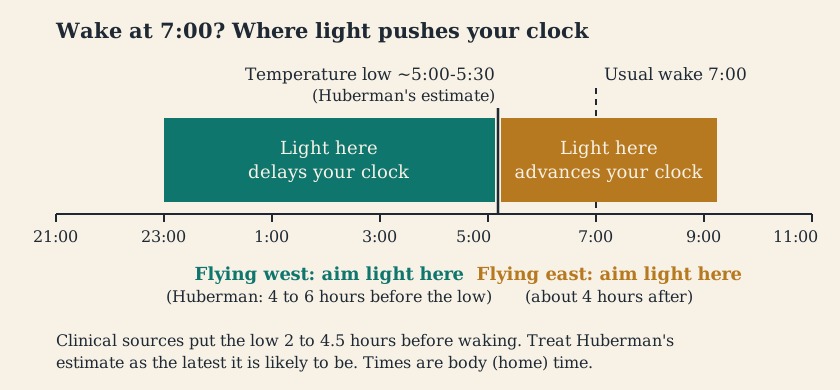
Convert it to destination time. Your body keeps home time for the first days. A 5 a.m. low in New York falls at 10 a.m. in London, so on day one, light before 10 a.m. there pushes you the wrong way and late-morning light helps. As your clock shifts, the low moves earlier each day.
Eastward travel: how to advance your clock
Flying east means falling asleep earlier than your body wants, and as Huberman says, "falling asleep earlier is harder." The CDC's reason is that the body clock runs slightly longer than 24 hours, so it delays more easily than it advances. The Sleep Foundation says roughly 75% of people find jet lag worse going east.
Two or three days before you fly:
- Get up earlier each day, by 30 to 45 minutes in Huberman's newsletter or an hour in the CDC advice and lab studies.
- Get bright light soon after waking.
- Don't rush. Shifting sleep 2 hours a day was no better than 1 hour, and people struggled to fall asleep (Eastman et al., 2005).
In a lab study of 28 young adults, three days of hour-earlier sleep plus bright morning light moved the clock 1.5 to 2.1 hours earlier, against 0.6 hours in dim light (Burgess et al., 2003).
“"If you expose your eyes to bright light in the four hours after your temperature minimum, your circadian clock will shift so that you will tend to get up earlier and go to sleep earlier in the subsequent days."
Andrew Huberman, Huberman Lab Essentials, 10:40
“
On arrival, find where your low falls on local time, get bright light in the hours after it, and avoid it in the hours before.
How fast? Huberman says this can shift your clock "anywhere from one to three hours per day". After real flights, clocks move about an hour a day eastward on average (CDC), so a nine-hour jump left to chance can take over a week.
Westward travel: how to delay your clock
Staying up later is easier. The CDC puts average adjustment at 1.5 hours a day westward, against 1 hour eastward.
Before you fly, shift bed and wake times 30 to 45 minutes later a day (Huberman's newsletter), get light in the evening and keep early mornings dim. A CDC jet lag tips figure, adapted from the US Army's WRAIR, suggests dark sunglasses.
“"If you view bright light in the four to six hours before your temperature minimum, you will tend to phase delay your clock."
Andrew Huberman, Huberman Lab Essentials, 11:07
“
On arrival, say from Europe to California at 4 p.m., Huberman suggests sunlight around 6 or 8 p.m., or bright artificial light after dark, and moderate caffeine through the afternoon. The same CDC figure allows up to 200 mg every 4 hours in destination daylight, stopping 6 hours before bed.
Light exposure: your most powerful tool
Light is the strongest signal your clock gets; the Sleep Foundation calls it "the most powerful influence on circadian rhythm".
Huberman's everyday rule of thumb is at least 100,000 lux before 9 a.m., noting that outside "even on a cloudy day, could be 7,000, 10,000 lux." No study has tested that total. The daily version is in Huberman's full light exposure protocol.
| Source | Approximate lux |
|---|---|
| Outside under cloud | 5,000-10,000, sometimes up to 90,000 (Huberman's light meter) |
| Light therapy box | 10,000 (Mayo Clinic) |
| Light that shifted clocks in lab studies | over 3,000 to about 10,000 (Burgess 2003; Khalsa 2003) |
| Brightest lamp in a typical home | about 1,000 (Huberman's light meter) |
| Ordinary room light | under 200 (Gooley 2011) |
“"It takes very little photon energy to reset and shift our clock after 8:00 PM."
Andrew Huberman, Huberman Lab Essentials, 4:40
“
His rule is to keep light as low as is safe from about 10 or 11 p.m. to 4 a.m. Screens count too. People who read on a light-emitting e-reader before bed had later body clocks than with a printed book (Chang et al., 2015).
Food and exercise timing
Light is the strongest cue (Sleep Foundation). Meals and exercise help too.
Food. Eat at local times, even if you're not hungry, as Huberman's newsletter puts it. When 10 young men had every meal moved 5 hours later, their blood-sugar rhythm shifted about 5.7 hours, while melatonin and cortisol, markers of the brain's master clock, didn't move (Wehrens et al., 2017).
Exercise. In a lab study of 99 adults, an hour of moderate treadmill exercise moved the clock earlier at 7 a.m. or between 1 and 4 p.m., and later between 7 and 10 p.m. (Youngstedt et al., 2019). Morning workouts suit an eastward trip; evening ones, a westward trip.
Huberman says you don't need all three of light, meals and exercise. Start with light.
Melatonin and sleep aids: what helps
Melatonin:
- Dose. In the Cochrane review, 0.5 to 5 mg worked about equally well, though people fell asleep faster and slept better on 5 mg than 0.5 mg. Above 5 mg did no better (Herxheimer & Petrie, 2002). The CDC says 0.5 to 1 mg is often enough to shift the clock and advises against more than 5 mg.
- Timing. Per the CDC, melatonin in your body's early evening moves the clock earlier, and in its morning, later. Taken at the wrong time, early in the day, it can make you sleepy and slow adjustment (Cochrane).
- Labels. In a Canadian test of 31 supplements, content ranged from 83% below to 478% above the label (Erland & Saxena, 2017).
The review found occasional short-term use appears safe, but flagged case reports of harm in people with epilepsy and people taking warfarin; see melatonin side effects. Huberman prefers light, exercise and temperature, saying melatonin for many people "is not going to be the best solution", which is why he leaves it out of his sleep stack.
Sleeping pills. The CDC lists hypnotics such as zolpidem (Ambien) as an option, with caveats about side effects, and advises avoiding antihistamines and long-acting benzodiazepines. They don't move your clock (Sleep Foundation), so you may still feel sleepy around your body's low if it falls in the local day (Eastman & Burgess, 2009).
Best approach. Start with timed light, because it moves the clock most; add 0.5 to 5 mg melatonin near local bedtime if you need it; use sleeping pills only on a doctor's advice.
The health stakes: why this matters beyond tired days
“"There are quality, peer-reviewed papers, showing that jet lag will shorten your life."
Andrew Huberman, Huberman Lab Essentials, 5:51
“
The best-known study behind it used old mice given a 6-hour shift in their light cycle every week for 8 weeks. With advances, 47% survived, against 68% with delays and 83% with no shifts (Davidson et al., 2006). Young mice generally survived well. It says little about one holiday.
For pilots, flight attendants and frequent business travellers, the Sleep Foundation says a clock that stays out of sync may raise the risk of diabetes, depression and some cancers.
In the same episode Huberman describes waking at 3 a.m., doing an NSDR session and falling back asleep. NSDR.co is free; see the best times to practise NSDR.
Common mistakes to avoid
1. Bright light at the wrong time. Light before your low pushes you later.
2. Relying only on melatonin. Pairing it with timed light may help more (CDC).
3. Long naps. Keep naps to 20 to 30 minutes (CDC) and at least 8 hours before bedtime (Sleep Foundation). Huberman calls a planned 20-minute nap that runs to four hours "the worst thing you can do". See how to nap without waking up groggy.
4. Screens late at night. Dim your phone or put it away.
5. No preparation for big jumps. For six or more time zones, start two or three days ahead. Home and still off? Try a 7-step plan to reset your sleep schedule.
FAQ
How long does jet lag last?
Jet lag usually lasts 1 to 1.5 days per time zone crossed, the Sleep Foundation says, so a six-hour shift can take six to nine days. Huberman says preparation can cut a Europe trip to 24 to 36 hours, though no study has tested that.
Is jet lag worse traveling east or west?
Jet lag is worse traveling east for most people. Roughly 75% find eastward trips harder (Sleep Foundation). The body clock delays more easily than it advances (CDC).
What's the best melatonin dose for jet lag?
The best-supported melatonin dose for jet lag is 0.5 to 5 mg, close to bedtime at your destination, with nothing gained above 5 mg (Cochrane). The CDC says 0.5 to 1 mg is often enough to shift the clock.
Can you prevent jet lag completely?
You can prevent jet lag completely on short trips. Away less than two days? Stay on home time (CDC tips figure). For six or more time zones, jet lag sleep tips such as pre-flight shifting give you a head start, and the Burgess team suggests more days of it could potentially eliminate jet lag.
Do jet lag apps work?
Jet lag apps such as Timeshifter and StopJetLag build a schedule from your flights. The CDC notes these calculators base their light and melatonin advice on phase-response curves. They do the arithmetic for you, but none of the sources here tested the apps themselves.
Sources
- Huberman A. Huberman Lab Essentials: "How to Defeat Jet Lag, Shift Work & Sleeplessness". YouTube. https://youtube.com/watch?v=In9Bq4EJMZw
- Huberman Lab newsletter (2024). "Defeat Jet Lag". https://www.hubermanlab.com/newsletter/defeat-jet-lag
- Riedy SM, Williams SG (2025). "Jet Lag Disorder". CDC Yellow Book 2026: Health Information for International Travel. https://www.cdc.gov/yellow-book/hcp/travel-air-sea/jet-lag-disorder.html
- Sleep Foundation. "Jet Lag". Medically reviewed by Abhinav Singh MD. https://www.sleepfoundation.org/travel-and-sleep/jet-lag
- Khalsa SB, Jewett ME, Cajochen C, Czeisler CA (2003). A phase response curve to single bright light pulses in human subjects. Journal of Physiology. https://pubmed.ncbi.nlm.nih.gov/12717008/
- Eastman CI, Burgess HJ (2009). How to travel the world without jet lag. Sleep Medicine Clinics. https://pubmed.ncbi.nlm.nih.gov/20204161/
- Burgess HJ, Crowley SJ, Gazda CJ, Fogg LF, Eastman CI (2003). Preflight adjustment to eastward travel: 3 days of advancing sleep with and without morning bright light. Journal of Biological Rhythms. https://pubmed.ncbi.nlm.nih.gov/12932084/
- Eastman CI, Gazda CJ, Burgess HJ, Crowley SJ, Fogg LF (2005). Advancing circadian rhythms before eastward flight: a strategy to prevent or reduce jet lag. Sleep. https://pubmed.ncbi.nlm.nih.gov/15700719/
- Herxheimer A, Petrie KJ (2002). Melatonin for the prevention and treatment of jet lag. Cochrane Database of Systematic Reviews. https://pubmed.ncbi.nlm.nih.gov/12076414/
- Erland LA, Saxena PK (2017). Melatonin natural health products and supplements: presence of serotonin and significant variability of melatonin content. Journal of Clinical Sleep Medicine. https://pubmed.ncbi.nlm.nih.gov/27855744/
- Wehrens SMT, Christou S, Isherwood C, et al. (2017). Meal timing regulates the human circadian system. Current Biology. https://pubmed.ncbi.nlm.nih.gov/28578930/
- Youngstedt SD, Elliott JA, Kripke DF (2019). Human circadian phase-response curves for exercise. Journal of Physiology. https://pubmed.ncbi.nlm.nih.gov/30784068/
- Chang AM, Aeschbach D, Duffy JF, Czeisler CA (2015). Evening use of light-emitting eReaders negatively affects sleep, circadian timing, and next-morning alertness. PNAS. https://pubmed.ncbi.nlm.nih.gov/25535358/
- Gooley JJ, Chamberlain K, Smith KA, et al. (2011). Exposure to room light before bedtime suppresses melatonin onset and shortens melatonin duration in humans. Journal of Clinical Endocrinology and Metabolism. https://pubmed.ncbi.nlm.nih.gov/21193540/
- Davidson AJ, Sellix MT, Daniel J, Yamazaki S, Menaker M, Block GD (2006). Chronic jet-lag increases mortality in aged mice. Current Biology. https://pubmed.ncbi.nlm.nih.gov/17084685/
- Mayo Clinic. Seasonal affective disorder treatment: Choosing a light box. https://www.mayoclinic.org/diseases-conditions/seasonal-affective-disorder/in-depth/seasonal-affective-disorder-treatment/art-20048298
- Huberman Lab. "Sleep Toolkit: Tools for Optimizing Sleep & Sleep-Wake Timing" (2022), light-meter demonstration. https://www.hubermanlab.com/episode/sleep-toolkit-tools-for-optimizing-sleep-and-sleep-wake-timing